
Grilling in Winter: Keep Your Gas Grill Running in the Cold
Cold air, wind and a chilled propane tank all change how your grill behaves. Here is what to adjust so it lights and holds heat all winter.
Short answer: a gas grill works fine in winter, but it needs a longer preheat, a spot out of the wind, a propane tank and regulator that are not struggling, and burners and an igniter that stay dry. Do those four things and most cold-weather problems never show up.
What cold air and wind actually do to a gas grill
A grill is a metal box that loses heat to the air around it. In cold, windy weather it loses heat faster. The burners can be running at full flame while the lid thermometer barely moves, because wind pulls heat out through the lid seams, the vents and the sides of the firebox.
Wind also hits the flame itself. A strong gust at the back or side of the grill can push flames off the burner ports or blow them out. That is one of the common reasons a grill goes out partway through a cook. If that happens often, see Gas Grill Keeps Going Out? 9 Reasons Your Grill Won't Stay Lit.
Cold also affects propane, which we cover below. Natural gas grills do not have a tank to worry about, but they still lose heat to cold air and wind, and the igniter and burners still need to stay dry.
Preheat longer than you do in summer
In mild weather most gas grills are ready in 10 to 15 minutes. In the cold, plan on 5 to 10 minutes more. That is a rule of thumb from the field, not a spec. Your grill's size, grate material and the wind all change it.
- Light all the burners you plan to use, close the lid, and set them to high.
- Wait until the lid thermometer reaches your target, then give it a few more minutes. The air inside gets hot first. The grates, and the metal under them, take longer.
- Cold grates pull heat out of food and cause sticking and weak sear marks. Fully heated grates fix both.
- Keep the lid closed while cooking. Every time you open it in cold air you lose more heat than you would in July.
Lid thermometers also read differently in cold weather, so a probe thermometer in the food is more reliable than the dial. If you want a refresher on target temperatures, read How Hot Should a Gas Grill Get?
Put the grill where the wind can't reach it
For a freestanding or cart grill, turn the back of the grill toward the prevailing wind. Keep it outdoors, in the open, and away from walls, fences, eaves and anything that can burn. Follow the clearances in your owner's manual. Never move a lit or still-hot grill into a garage, porch or enclosed space to get out of the weather. Carbon monoxide and fire risk are real.
For a built-in grill, you can't move it, so you work around it. Look at which direction the wind comes from at the island and consider a windbreak, such as a planter wall or a screen, set at a safe distance. Do not block the vents on the island or the grill's own vents. Built-ins need airflow to burn properly and to release heat.
Check the propane tank and regulator in the cold
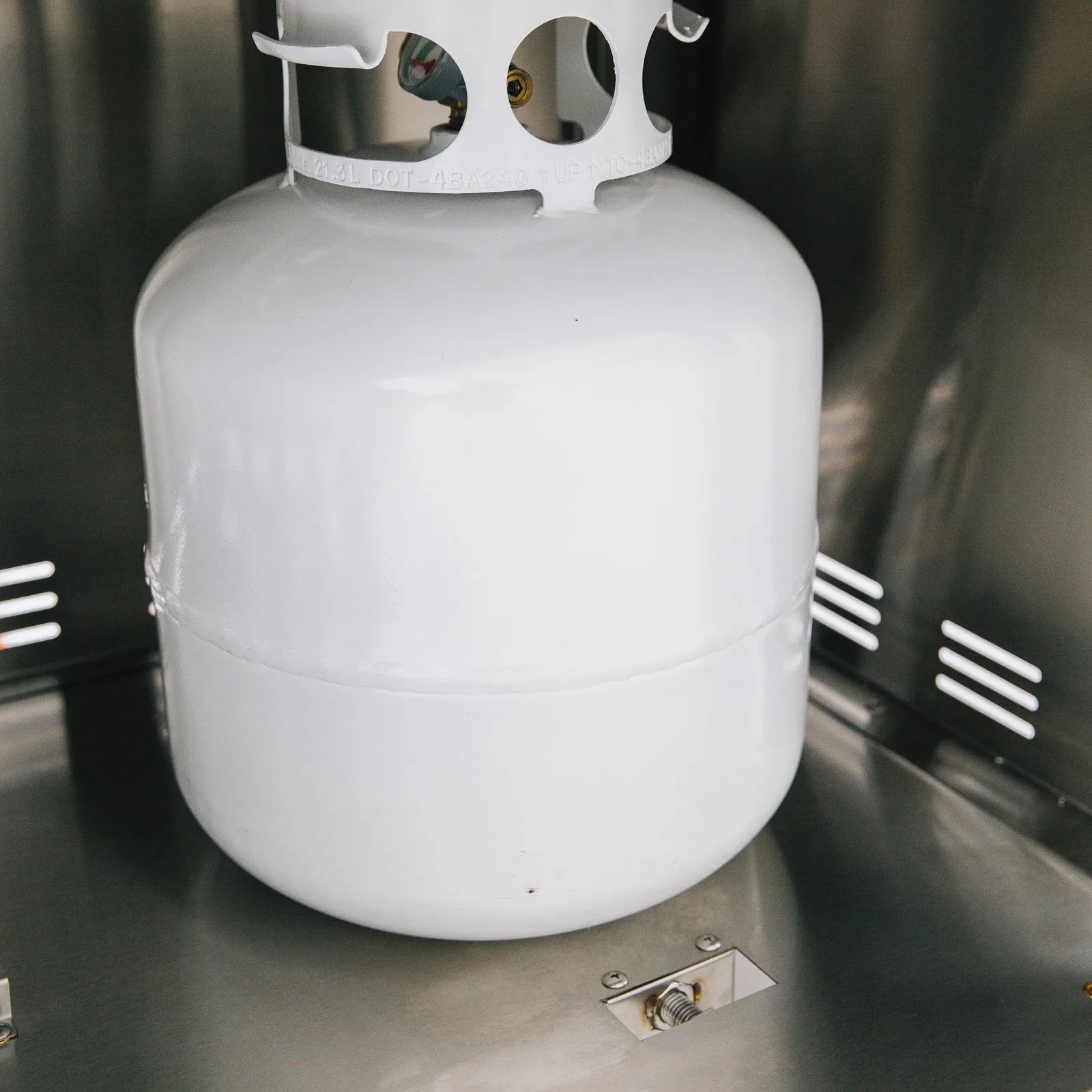
Propane is stored as a liquid and has to boil into vapor before it reaches the burners. It gets the heat for that from the tank wall and the air around it. When the tank is cold, it makes vapor more slowly and the pressure drops. Run the grill hard on a cold day and a tank that is low on fuel can't keep up, so the flames shrink.
Here is what we check:
- Tank level. Start winter with a tank you know is not nearly empty. A half-full tank in cold weather gives you less margin than the same tank in summer. Keep a spare if you cook often.
- Frost on the tank. Frost low on the tank means it is working hard. Lower the burner settings or cook with fewer burners. Never warm a tank with a flame or boiling water. Move the grill out of the wind and let the tank recover.
- Regulator vent. Make sure the small vent on the regulator is clear of snow, ice, dirt and spider webs.
- Hose. Hoses stiffen in the cold. Look for cracks, cuts and kinks, and check that the hose is not touching hot metal.
- Leak check. Brush soapy water on the connections with the tank open and the burners off. Bubbles mean a leak. Never use a flame to look for one.
If the flame is low or weak even though the tank has gas, the regulator may have tripped its flow-limiting device. Reset it this way:
- Turn all burner knobs off and close the tank valve.
- Disconnect the regulator from the tank, then reconnect it snugly by hand.
- Open the tank valve slowly, about a quarter turn at first, then fully.
- Wait about 30 seconds, then light the grill as usual.
If that doesn't help, work through Grill Not Getting Gas With a Full Propane Tank? What to Check. Regulators and hoses wear out, and a replacement is much cheaper than a bad cook night.
If you smell gas, turn off the tank valve and every burner, step away, and do not try to light anything. Call a pro. Don't use the grill until it has been checked.
Keep the burners and igniter dry
Winter means rain, dew, snow and condensation. Water in the wrong place causes most of the "it won't light" calls we see this time of year.
- Burner ports. Water and rust in the ports block gas flow and give you uneven or yellow flames. After a rainy stretch, run the burners on high with the lid open for a few minutes to dry them out.
- Igniter electrode. The electrode sits near the burner and is usually a small ceramic tip with a metal pin. If it is wet or sooty, the spark jumps to the wrong place or doesn't happen. Wipe it dry and clean.
- Igniter battery. If your grill uses a battery-powered igniter, cold weather drains the battery fast. Replace it at the start of winter.
- Cover. Use a cover that fits the grill, and put it on only after the grill is completely cool. A cover over a damp grill traps moisture. A vented cover is better in wet weather.
- Manual lighting. Many grills have a match-light hole or a way to light the burner by hand. Know how to use it, so a dead igniter doesn't end the cook. Follow your manual and keep the lid open when you light.
If the grill clicks but never lights, even when everything is dry, start with Grill Won't Light? Common Causes & What to Check.
When the cold shows what was already wrong
Cold weather doesn't usually break a grill. It exposes parts that were already worn. Igniters, burners and briquette trays are the parts we see fail most often, and igniters are the most common fix. If your igniter has stopped sparking and is wet-proof dry and clean, it may simply be done. Igniters can cost as much as $60 each, and that price varies by brand and model.
We also sell parts for Lynx grills. We don't sell Lynx grills, but plenty of owners want to repair theirs and keep cooking on them, and we're glad to help with that. You can look up parts through the Pro Grill parts store.
Burners and rust holes are a different level of problem. If you see holes in the firebox, stop using the grill. We don't recommend repairing a hole in a firebox, and we don't do it. Replacement is the answer there.
If you're not sure what's wrong, a professional inspection and diagnosis visit is $199 with Pro Grill. If you do any work with us, we give 50% of that fee back, and it can also be credited toward a new grill purchase. We cover Southern California and Arizona. Outside those areas, you can find an insured grill pro near you.
A quick winter checklist
| Before you cook | What to do |
|---|---|
| Wind | Back of the grill to the wind, outdoors, clear of anything that can burn |
| Tank | Enough fuel, no heavy frost, spare on hand |
| Regulator and hose | Vent clear, no cracks, soapy-water leak check |
| Igniter | Electrode dry and clean, fresh battery if it uses one |
| Burners | Dry them out on high, lid open, if it has rained |
| Preheat | 5 to 10 minutes longer than summer, lid closed |
A grill that is clean and in good shape handles the cold better than one with clogged ports and greasy burners. If you haven't cleaned yours since summer, a cleaning helps, though it won't fix parts that need repair. Then enjoy the cooking. Winter is a good season for it.
FAQ
Can you use a gas grill in cold weather?
Yes. Plan on a longer preheat, put the grill where the wind can't blow on it, and make sure the propane tank, regulator and igniter are in good shape and dry.
Why is my propane grill flame low when it's cold?
A cold tank makes less propane vapor, so pressure drops, especially on a low tank or on high settings. A tripped regulator can do the same thing. Turn everything off, reset the regulator, and check the tank level.
How long should I preheat my grill in winter?
As a rule of thumb, add 5 to 10 minutes to your normal preheat of 10 to 15 minutes, with the lid closed. Wait until the grates are fully hot, not just the lid thermometer.
Why won't my grill light when it's cold or wet?
A wet or sooty igniter electrode, a weak battery, water in the burner ports or a low or frozen regulator are the usual causes. Dry and clean the parts, replace the battery and try again.
More seasonal
See all →
Get Your Outdoor Kitchen Ready for Fall and Holiday Cooking
Cooler weather puts you at the island more often. Here is what to check first, what you can do yourself, and what to hand to a pro before guests show…
Power Out? Never Heat Your Home With a Grill or Fire Pit
A grill, fire pit or patio heater is built for open air. Used inside, or under a roof, it can fill a home with carbon monoxide. Here is what to do in…
Store a Propane Tank Full or Empty for Winter? A Tech Answers
The question most people ask is full or empty. The question that matters more is where the tank sits and what shape it's in before you put the cover …