Gas Grill Won’t Stay Lit? Why It Lights Then Goes Out
If your gas grill lights but won’t stay lit, the problem is different from a grill that will not ignite at all. The burner is receiving enough gas to light, but something is preventing the flame from remaining stable.
That can happen because of restricted fuel flow, regulator problems, dirty or deteriorated burners, valve issues, wind, incorrect burner positioning or other problems inside the grill.
Below are some of the most common reasons a gas grill lights and then goes out, along with signs that can help narrow down the cause.
Why Does My Gas Grill Light and Then Go Out?
For a gas grill to remain lit, it needs a steady supply of fuel, correct gas pressure, proper airflow and burners that can distribute gas evenly.
If any of those conditions change after ignition, the burner may light normally and then shut off seconds or minutes later.
The exact behavior often gives useful clues. Does the flame become smaller before it goes out? Does the problem occur only when you turn on a second burner? Does it happen only in windy weather? Is one burner affected, or does the entire grill shut down?
1. The Grill Is Not Getting Enough Fuel
A low or inconsistent fuel supply is one of the first things to consider when a gas grill won’t stay lit.
With a propane grill, the cylinder may be nearly empty. With a natural-gas grill, there may be an issue affecting the amount of gas reaching the appliance.
A grill can sometimes ignite even when the available fuel flow is marginal. Once the burners begin demanding more gas, however, the flame may weaken and eventually go out.
Possible signs include:
- Very small burner flames.
- Slow preheating.
- The flame weakens when another burner is turned on.
- The grill cannot reach its normal cooking temperature.
If your grill stays lit but produces poor heat, see our guide on why a gas grill is not getting hot.
2. A Propane Regulator May Be Restricting Gas Flow
Propane grills rely on a regulator to control gas pressure between the propane cylinder and the grill.
If gas flow becomes restricted, the grill may still ignite but operate with unusually weak flames. In some cases, the burners may eventually go out because there is not enough gas flow to maintain combustion.
Homeowners sometimes describe this as the grill being stuck in a low-flame or low-flow condition.
Possible symptoms include:
- All burners have weak flames.
- The grill suddenly takes much longer to heat.
- Adding another burner causes the existing flames to weaken.
- The grill worked normally before a propane-cylinder change and now performs poorly.
Because the regulator is part of the fuel system, it should not be modified, bypassed or repaired with makeshift parts. The U.S. Consumer Product Safety Commission’s gas grill safety guidance also recommends inspecting gas hoses and connections and not using a grill when a gas leak is present.
3. Dirty or Clogged Burners Can Cause an Unstable Flame
A burner does more than simply release gas. It must distribute fuel evenly through many small burner ports while mixing it with the correct amount of air.
Grease, rust, food residue, insects and other debris can interfere with those burner ports.
When enough openings become restricted, the flame pattern may become uneven or unstable. In severe cases, part of the burner may light while another section repeatedly goes out.
Common symptoms include:
- Only part of the burner stays lit.
- The flame moves unevenly across the burner.
- The burner repeatedly goes out in the same area.
- The grill heats unevenly.
- The flames have changed color or appearance.
Learn more about BBQ burner cleaning, repair and replacement.
4. The Burner May Be Worn Out
Not every burner problem can be corrected with cleaning.
Gas grill burners live in an extremely harsh environment. They are repeatedly exposed to high temperatures, grease, moisture and outdoor conditions.
Over time, burner metal can corrode, split, crack or develop enlarged burner openings.
Once the burner is physically deteriorated, gas may no longer flow through it as designed. This can create uneven flames, poor heat and burners that will not remain lit.
A dirty burner may be cleanable. A burner with major corrosion, holes or splitting generally needs replacement.
5. The Burner May Not Be Positioned Correctly
Gas must enter the burner correctly from the valve and orifice.
If the burner has shifted, was installed incorrectly after cleaning or repair, or is no longer held securely in place, the gas-and-air mixture entering the burner may be affected.
This can sometimes happen after burner replacement or when mounting points inside an older grill have deteriorated.
Because burner alignment involves the fuel-delivery system, a burner that does not appear to be properly positioned should be inspected before the grill is used again.
6. A Grill Valve Could Be Causing the Problem
The gas valves behind your control knobs regulate how much gas is delivered to each burner.
If a valve is damaged, contaminated or worn, the burner may not receive consistent gas flow.
One useful clue is whether the problem affects only one burner.
If three burners operate normally but one repeatedly goes out, the problem may be related to that burner’s components rather than the entire gas supply.
Pro Grill provides professional BBQ grill valve repair and replacement when a valve problem is properly diagnosed.
7. Wind May Be Blowing Out the Burner
Not every flame problem originates inside the grill.
Strong wind can disrupt burner flames, particularly when an outdoor kitchen is located in an exposed area or where surrounding walls funnel wind directly toward the grill.
This can be especially noticeable on elevated properties, coastal homes and open patios.
If your grill works normally on calm days but repeatedly goes out when it is windy, the installation location may be contributing to the problem.
Do not solve this by enclosing the grill or blocking required ventilation. Built-in grills need proper airflow and ventilation for safe operation.
Gas Grill Won’t Stay Lit?
Pro Grill can inspect the burner system, fuel-related components and other grill parts to identify why the flame keeps going out.
1-800-860-67588. Grease and Debris May Be Affecting Airflow
Gas burners require oxygen to maintain proper combustion.
Heavy grease and debris inside a neglected grill can interfere with airflow around burners and other internal components.
The cooking grates may look reasonably clean while the lower portion of the grill contains years of grease, carbon and food debris.
Depending on the grill design, buildup can collect around:
- Burners.
- Briquette trays.
- Heat shields.
- Firebox surfaces.
- Grease-management systems.
- Ventilation openings.
Professional BBQ grill cleaning removes buildup from areas that are often overlooked during routine homeowner cleaning.
At Pro Grill, our deep-cleaning process uses food-safe cleaning products and high-temperature steam to remove grease and buildup while allowing our technicians to inspect visible internal components for deterioration.
9. Several Grill Components May Be Worn at the Same Time
Older grills often have more than one problem.
For example, a grill may have partially clogged burners, deteriorated briquette trays, aging valves and an ignition system that is also beginning to fail.
Replacing one obvious component may improve the grill without fixing every symptom.
That is why professional diagnosis can save money compared with repeatedly replacing parts by guesswork.
If your grill has multiple symptoms — difficulty lighting, weak heat, uneven flames and burners that will not stay lit — consider a professional BBQ grill inspection.
What If My Grill Lights and Goes Out Immediately?
If the burner shuts off within seconds of ignition, first notice whether the problem occurs on one burner or across the entire grill.
If all burners behave similarly, the cause may involve something shared by the entire grill, such as fuel supply or regulation.
If only one burner goes out while the others remain stable, that points more strongly toward that burner, its valve, its positioning or another local component.
If your grill does not light at all, that is a different problem. See our guide to what to check when a grill won’t light.
Why Won’t My Propane Grill Stay Lit?
A propane grill that will not stay lit can have several possible causes, including:
- Low propane supply.
- Restricted gas flow.
- A regulator problem.
- Dirty burner ports.
- A deteriorated burner.
- A valve problem.
- Improper burner positioning.
Changing the propane tank may solve a simple low-fuel issue, but it will not correct a mechanical problem within the grill.
If a known-good propane supply does not change the symptoms, the grill should be inspected before parts are replaced at random.
Why Won’t My Natural Gas Grill Stay Lit?
Natural-gas grills can experience many of the same burner, valve and airflow problems as propane grills.
They can also have issues related to gas supply and appliance configuration.
A grill must be correctly configured for the fuel type being supplied. Natural gas and propane use different fuel-system components and should never be treated as interchangeable.
Do not drill gas orifices or attempt an improvised fuel conversion to solve a low-flame or flame-out condition.
Can a Dirty Grill Cause the Flame to Go Out?
Yes, heavy buildup can contribute to unstable burner performance, particularly when burner openings or airflow areas become obstructed.
However, cleaning is not always the complete solution.
Once grease and debris are removed, technicians sometimes discover that the burner or other components underneath are already physically deteriorated.
Cleaning removes buildup. Inspection determines whether the underlying parts are still in good condition.
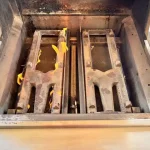
What Should a Healthy Gas Grill Flame Look Like?
Exact flame appearance varies by manufacturer and burner design, but a healthy gas-grill flame should generally be stable and consistent.
The flame should not repeatedly lift away from the burner, disappear in sections or extinguish during normal operation.
If the flame has suddenly become very yellow or behaves differently than it did previously, see our guide to yellow flames on a gas grill.
Should I Keep Relighting a Grill That Keeps Going Out?
No. If the burner repeatedly goes out, do not simply continue lighting it without finding the cause.
Repeated ignition attempts can become dangerous if unburned gas accumulates inside the grill before another ignition attempt.
Does My Grill Need Repair or Replacement?
A grill that will not stay lit does not automatically need replacement.
Many premium built-in grills are worth repairing, particularly when the body, hood and outdoor-kitchen installation remain in good condition.
The decision usually depends on:
- The grill’s age.
- The overall condition of the appliance.
- The number of failed components.
- Availability of replacement parts.
- The original quality and value of the grill.
- Repair cost compared with replacement cost.
If replacement makes more sense, Pro Grill also provides BBQ grill replacement and installation.
Professional Gas Grill Inspection and Repair
Burners, valves, regulators, igniters, electrodes, manifolds, orifices and briquette systems all work together to keep a gas grill operating properly.
Pro Grill services many leading grill brands and can diagnose problems involving BBQ ignition systems, burners, gas valves, briquette trays, grates and other BBQ grill parts.
Frequently Asked Questions
Why does my gas grill light but not stay lit?
Common causes include inadequate fuel flow, regulator issues, dirty or deteriorated burners, gas-valve problems, incorrect burner positioning, airflow problems or wind.
Why does my propane grill light and then go out?
A propane grill may light and then go out because of low propane, restricted gas flow, regulator problems, dirty burners or worn fuel-system components.
Why does my grill go out when I turn on another burner?
If the existing flames become noticeably weaker when another burner is turned on, the grill may not be receiving enough fuel flow to support all burners at the same time.
Can clogged burners cause a gas grill to go out?
Yes. Blocked burner ports can interfere with gas distribution and produce unstable flames. Burners should also be inspected for corrosion or physical damage.
Can wind cause a grill burner to go out?
Yes. Strong or concentrated wind can disrupt burner flames. However, do not block required ventilation around a built-in grill in an attempt to stop the wind.
Is it safe to keep relighting a grill that goes out?
No. If a burner repeatedly goes out, determine why before continuing to relight it. Stop using the grill if you smell gas or suspect a fuel-system problem.
Get Your Grill Working Properly Again
If your gas grill lights but won’t stay lit, Pro Grill can inspect the appliance, determine what is causing the flame to go out and recommend the appropriate repair.
1-800-860-6758