
Holes in Your Grill's Firebox: Stop Using It and Call a Pro
A hole in the firebox is a safety problem, not a cosmetic one. Here is why the grill has to stop being used, what to do today, and what comes next.
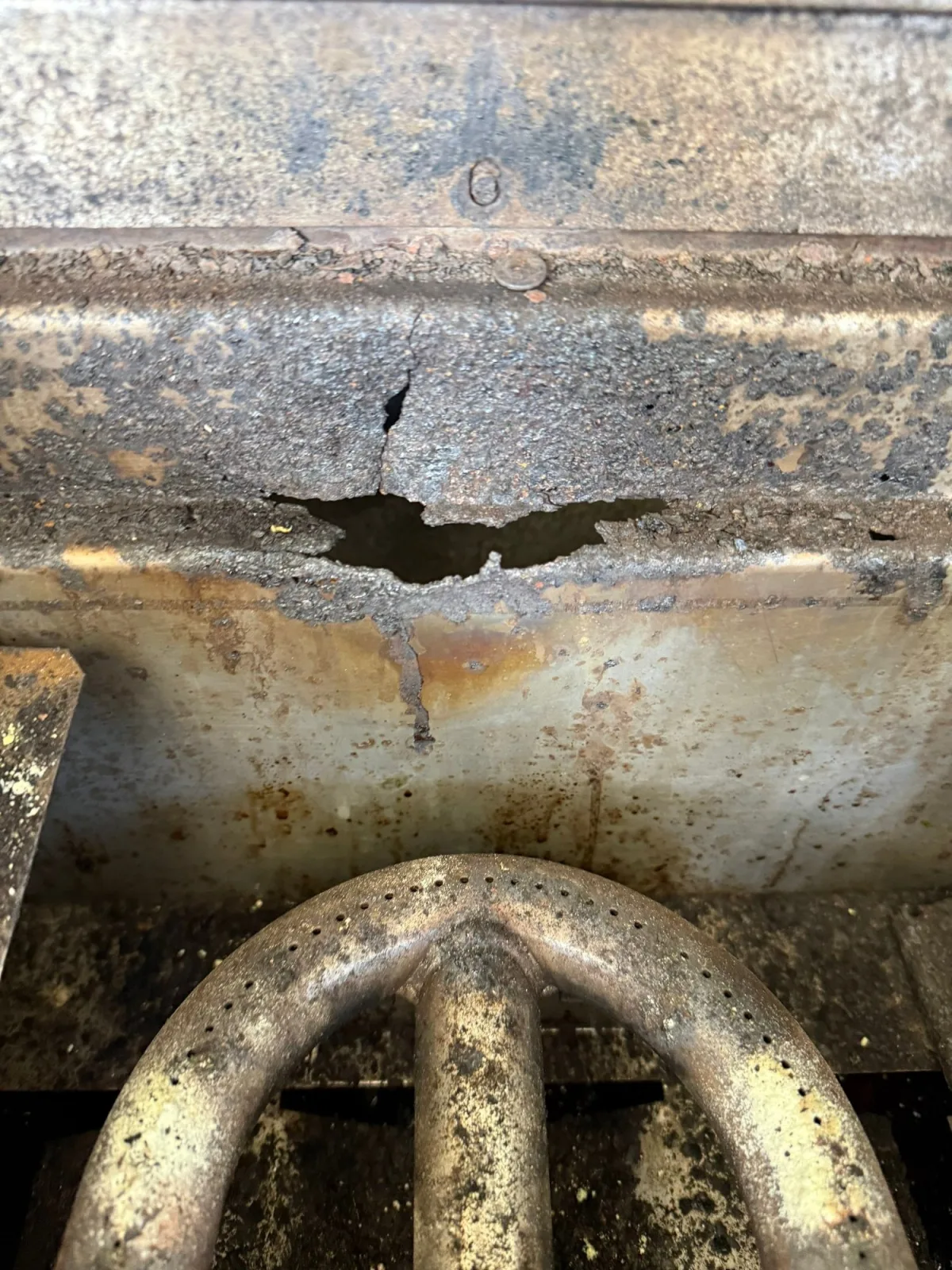
If you can see through the metal of your grill's firebox, stop using the grill. Shut off the gas at the tank or supply valve, let it cool, and call a pro. A firebox with burn-through or rust holes lets gas, flame and heat escape where they were never meant to go, and a patch will not make it safe again. In almost every case the answer is a replacement grill.
What the firebox is and why a hole matters
The firebox is the cooking body of the grill, the metal tub under the lid that holds the burners, briquette trays or heat plates, and the grease path. It has two jobs. It keeps the flame and heat inside, and it controls how air reaches the burners so the flame burns clean and the temperature stays where you set it.
A hole breaks both jobs. Think of it as a part that failed, not a spot that looks bad. The metal around that hole is usually thin too, even if it looks fine.
Why a holed firebox is not safe to keep using
Flame and hot gas escape
Burners put out a lot of heat inside a small space. Through a hole, flames and superheated air can push out into the cabinet or island. Grease that drips inside can also run out through the hole and burn where you cannot see it.
Your island is at risk
Most built-in grills slide into an island cutout. That island may have framing, insulation, wiring or gas lines around the grill. A properly working firebox keeps the heat on the cooking side. A holed one sends heat toward all of that. Damage from this tends to show up out of sight, behind the grill, until it becomes a bigger problem.
Heat control stops working
Burners are designed around a closed box with controlled airflow. A new opening pulls in extra air or lets flame roll out. You can get flames that lift, flicker or burn yellow, hot spots, and a temperature that does not match the knob settings. Any of those can make the grill harder to control while you stand next to it.
Gas is part of the picture
If you smell gas at any point, turn off the burners and the gas supply, step away, keep flames and sparks out of the area, and call a pro. Do not try to light the grill to see what happens.
What causes holes and burn-through
Fireboxes do not usually fail overnight. The metal wears down over years, and a few things speed that up:
- Grease and carbon buildup. Old grease holds moisture against the metal, and grease fires burn hot enough to thin it. See why grease buildup is a serious risk.
- Moisture and salt. Coastal air, sprinklers that hit the grill, and covers left on a wet or hot grill keep the metal damp. Rust starts from the bottom and the corners first.
- Thin or lower-grade metal. Some fireboxes are made from thinner stainless or coated steel that cannot take years of heat cycles and moisture.
- Constant high heat. Repeated hard heating and cooling flexes the metal, and the weakest spot cracks or burns through.
- Hidden trouble. Rodent nests, leaking regulators or hoses, and failed briquette trays can all aim extra heat at one spot.
How to tell a real problem from normal wear
Not every mark on a firebox is a hole. Use this as a quick check, with the grill off and fully cool.
| What you see | What it usually means |
|---|---|
| Brown, blue or gold tint on the metal | Normal heat discoloration |
| Light surface rust that wipes off | Surface rust; clean it and keep it dry |
| Flaking, bubbling or crumbling metal | The metal is thinning; get it inspected |
| Metal that gives or breaks when pressed gently | Rust-through is close or already there |
| A hole, crack or gap you can see through | Stop using the grill |
| Daylight visible inside the box in a dim garage or at dusk | There is a hole, even a small one |
Wear gloves, and do not poke at a corroded firebox hard enough to make the damage worse.
What to do right now
- Stop cooking on it. That includes just warming something up for a minute.
- Shut off the gas. Turn off the burner knobs, then close the propane tank valve or the natural gas shutoff.
- Let it cool completely before you touch or look closely at anything.
- Check the island around the grill. Look for scorched, bubbled or discolored surfaces, soot streaks, melted trim and any burnt smell.
- Take photos of the holes and of any island damage. They help a tech judge it faster.
- Do not patch it. No foil, no high-temperature cement, no sealant, no metal tape.
- Keep kids and pets away and keep the cover off a hot grill. Let it cool first, then cover it to keep rain out.
- Call us. Phone is 800-860-6758 and text is 888-418-4226.
Why we do not patch fireboxes
We do not repair holes in fireboxes, and we do not recommend anyone does. Welding a small hole in a stainless firebox can look like a fix. The problem is that the hole is just the first place the metal gave out. The metal around it is thinner and has been through the same heat, grease and moisture. Heat from a weld can warp the box. Patches then crack or pull away as the metal expands and contracts every time the grill is lit.
A patched firebox also still has to hold gas flames, grease and heat inside an island. If the repair fails, it fails at the worst time. We are not willing to put our name on that, so we do not do it.
What the inspection looks like
A professional visit to inspect and diagnose the grill is $199. The tech checks the firebox, hood, burners, igniters, gas connections and the island around the grill, then tells you plainly what is what. If you do any work with us, 50% of the fee comes back. That includes buying a replacement grill from us.
Here is how we usually see it play out:
- Firebox is sound, but parts are worn. Briquette trays and igniter issues are what we see most, then burners. On higher-end grills we usually recommend replacing the parts when the firebox is in good shape.
- Firebox has holes or is rusting through. Replacing parts is money into a grill that cannot be made safe. We recommend replacing the grill.
For the bigger picture across all kinds of damage, read Neglected Grill: Clean, Repair or Replace? and Deciding to Repair or Replace Your BBQ.
A cleaning, which usually takes 2 to 4 hours, is not a fix for a holed firebox. It removes grease and carbon, but it cannot put metal back where it burned away.
If you own a Lynx
We sell Lynx parts, though not Lynx grills. Lots of Lynx owners love their grills and want to keep them going, and when the firebox is in good shape that makes sense. For a sense of scale, a typical Lynx burner runs over $500, a ProSear burner over $700, and igniters can be as much as $60 each. Labor can run $200 to $500 depending on how involved the parts are.
Those numbers are worth spending only on a firebox that is solid. If a Lynx firebox is holed, parts will not solve it, and we would point you to a replacement from the brands we do sell.
What replacing the grill looks like
We sell over a dozen brands, including Fire Magic, Alfresco, Blaze, Summerset, Lion, Cal Flame, Delta Heat, Twin Eagles, Kokomo and more. You can browse what we carry at store.progrill.com.
Fire Magic is our top pick for high-end buyers. Those grills are made in the USA by RH Peterson, and we sell a lot of them. We like the grills and the people who make them, who care a great deal about how the products perform. For other budgets, we will go over the options with you, based on the size of your island cutout, the gas type, and the features you actually use. For price ranges, see Cost to Replace a Built-In BBQ Grill. We will not repeat those tables here.
In our service area: white glove installation
If you are in Southern California or Arizona, our white glove installation covers:
- Removal of the old grill
- Installation of the new grill
- Haul away of the old grill
- A walk-through on how the new grill works
Check our locations page to confirm your area.
Outside our service area
We can still sell you a grill. Our price is matched to the internet price. You then hire an installer, and you can find an insured grill pro near you at progrill.com/find. Have your island cutout measurements and gas type ready (natural gas or propane) before you order. Most built-in grills slide into the island, so the new one needs to fit the opening you have, or the cutout has to be adjusted.
Do not wait on this one
A grill with a holed firebox can look fine from the front and still be dangerous. If you are not sure whether what you are seeing is a hole, call or text us with a photo and we will help you work out the next step. Phone 800-860-6758, text 888-418-4226.
Find your model on our parts diagrams, tap the part, and order it, or text a photo of the rating plate to 888-418-4226.
FAQ
Is it safe to use a grill with a hole in the firebox?
No. A hole lets flame, hot gas and grease escape toward the island and throws off burner airflow and temperature control. Shut off the gas, let it cool, and have a pro look at it.
Can a hole in a grill firebox be patched or welded?
We do not recommend it and we do not do it. The metal around a hole is usually thin as well, and patches crack or fail as the grill heats and cools.
What causes a grill firebox to rust through or burn through?
Grease and carbon buildup, constant moisture or salt air, thin metal, repeated high heat, and sometimes rodent nests or gas leaks that aim heat at one spot. It happens slowly over years.
How much does a grill inspection cost?
A Pro Grill inspection and diagnosis visit is $199. If you do any work with us, including buying a replacement grill, 50% of the fee comes back.
Do you install replacement grills outside Southern California and Arizona?
We can sell you a grill anywhere, with the price matched to the internet price. White glove installation is in our service area; elsewhere, find an installer at progrill.com/find.
More maintenance
See all →
DIY BBQ Maintenance Guide | Cleaning, Safety & Grill Care
Which grill upkeep jobs are safe to do at home, what to clean and inspect, and when worn parts or gas problems mean it's time to call a pro.
Grilling Safety: Keep Your BBQ Fun and Fire-Free
How to grill safely with gas or charcoal, where to place the grill, what to keep clear of it, and why regular degreasing cuts the risk of grease fire…

Deciding to Repair or Replace Your BBQ? Pro Grill’s Expert Guide
How to tell when a grill is worth repairing and when it's time to replace it, with the common signs on each side and what a tech looks at before maki…