Main Parts of a Barbecue Grill: A Complete Gas Grill Components Guide
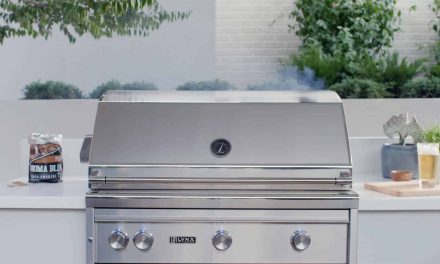
When it comes to the art of barbecue, there is more to it than tossing meat on a hot grate. Behind the savory aromas and great flavors is a carefully designed collection of BBQ parts working together to control gas, create flame, distribute heat, ignite the burners and manage grease.
Understanding the main parts of a barbecue can help you operate your grill more confidently, recognize developing problems and explain what is happening when you need professional grill repair.
Fuel moves through the regulator, hose, manifold, valves and orifices before reaching the burners. The ignition system lights that fuel. Briquettes, trays or heat shields distribute the heat, and the cooking grates transfer it to your food. If one component is dirty, damaged or incorrectly installed, it can affect the performance of everything around it.
At Pro Grill, we professionally clean, inspect and repair built-in and freestanding grills from many leading manufacturers. Once the internal components are removed, we regularly find problems that were hidden beneath grease and carbon: split burners, deteriorated briquette trays, damaged electrodes, rusted grates, blocked burner ports and grease-management systems that have not been emptied in years.
This guide explains the names and functions of the major parts of a gas grill, how those components work together and the symptoms you may notice when something begins to fail.
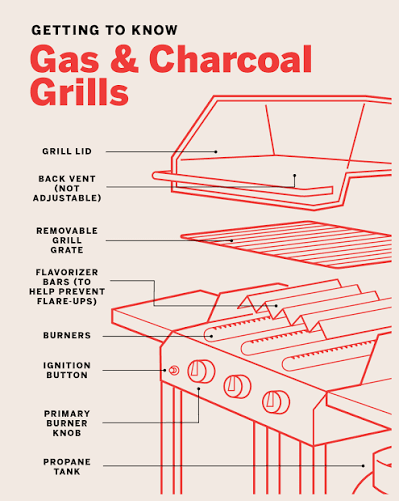
How the Main Parts of a Gas Grill Work Together
On a propane grill, fuel leaves the tank and passes through a regulator and hose. On a natural-gas grill, fuel enters through the properly configured gas connection. The manifold distributes gas to the individual control valves, and each valve meters gas through an orifice toward its burner.
Inside the burner, gas mixes with air and exits through the burner ports. The ignition system supplies the spark or other ignition source. Once lit, burner heat passes through ceramic briquettes, briquette trays, flame tamers or heat shields before reaching the cooking grates and food.
This is why the same symptom can have several possible causes. Low heat may involve a regulator, valve, orifice or burner. Uneven cooking may involve the burner, briquettes, trays, heat shields or grates. A grill that will not light may have a failed igniter—or the igniter may be working while another component prevents ignition.
Grill Body, Chassis and Firebox
The grill body or chassis is the foundation that supports the appliance. It holds the cooking system, control panel, hood and other components in their intended positions. Grill bodies are commonly made from stainless steel, cast aluminum or porcelain-coated steel.
The firebox is the high-heat chamber beneath the cooking surface. It surrounds the burners and heat-distribution components while containing heat, food debris and grease produced during cooking.
On a built-in grill, the firebox also sits inside an outdoor-kitchen island. Its dimensions, supports, clearances and ventilation requirements become particularly important when replacing the grill.
Possible Firebox Problems
- Heavy grease and carbon accumulation
- Corrosion, cracking or burn-through
- Damaged burner supports
- Blocked grease-drainage openings
- Warping or failure around mounting points
Surface dirt can be cleaned, but cleaning cannot replace metal that has rusted or burned away. The condition of the firebox is one of the most important factors when deciding whether an older grill is worth repairing.
Cooking Grates
Cooking grates are the surfaces that directly support your food. They may be constructed from stainless-steel rods, cast stainless steel, cast iron, porcelain-coated metal or other manufacturer-specific materials.
Their job seems simple, but the material, thickness and spacing of the grates affect heat transfer, searing, food release and cleaning requirements. Heavy cast grates retain heat differently than thinner stainless-steel rods.
Signs Cooking Grates Need Attention
- Heavy layers of burned food and carbon
- Deep corrosion or material loss
- Loose or flaking porcelain coating
- Broken welds or separated grate sections
- Warping that prevents the grate from sitting correctly
Cleaning methods should match the grate material. An abrasive that may be acceptable for one surface can permanently damage another. Learn more about BBQ cooking grate cleaning, care and replacement .
BBQ Burners
Burners are often called the heart of a gas grill. They receive metered fuel from the valves and orifices, mix that gas with air and distribute the mixture through a series of precisely designed ports. Once ignited, those ports create the flame that heats the grill.
Grill burners come in many designs, including straight and U-shaped stainless-steel tubes, cast stainless burners, cast iron burners, brass burners, infrared burners and specialized rear rotisserie burners.
A burner may be dirty without being damaged. Accessible surface residue and blocked ports may be cleanable if the burner remains structurally sound. Cleaning cannot correct a cracked burner, failed seam, severe corrosion, enlarged ports or missing metal.
Common Signs of a Burner Problem
- Only part of a burner lights
- One section produces a weak or uneven flame
- The grill develops hot and cold areas
- The burner has cracks, splits or irregular holes
- Ignition is delayed
- Flame appears near the burner inlet
- The grill no longer reaches its normal temperature
These symptoms do not automatically prove the burner itself has failed. Valves, regulators, orifices, ignition components and air-intake obstructions can create similar problems. Visit our complete guide to BBQ burner cleaning, problems, repair and replacement .
Heat Diffusers, Flame Tamers and Heat Shields
Heat diffusers sit between the burners and cooking grates. Depending on the manufacturer, they may be called heat shields, flame tamers, flavorizer bars, heat plates or radiant panels.
These parts help spread heat across the cooking area and shield the burners from direct food drippings. When drippings contact the hot surface, they can create the familiar grilled flavor, but excessive grease buildup can also produce smoke and flare-ups.
Heat diffusers eventually deteriorate because they are exposed to flame, moisture, grease and repeated heating and cooling. A burned-through or badly warped heat shield may create uneven cooking even when the burner below it is working correctly.
Ceramic Briquettes
Many premium grills use ceramic briquettes instead of metal heat shields. The briquettes absorb and radiate heat, helping create a more even cooking surface. They also intercept drippings before those drippings reach the burners.
Ceramic briquettes can become heavily coated with grease and carbon. They may also crack, crumble or disappear from sections of the tray. Missing or badly deteriorated briquettes can contribute to inconsistent heat and leave areas of the burner system more exposed.
Briquettes should be cleaned or replaced according to their material and the grill manufacturer’s recommendations. They should not be treated as universal parts: size, shape, composition and required placement can vary.
Learn more about ceramic BBQ briquette cleaning and replacement .
Briquette Trays
Briquette trays hold ceramic briquettes in their intended position above the burners. The tray must support the weight of the ceramics while withstanding direct heat, grease and outdoor moisture.
Over time, tray screens and frames can warp, corrode or burn through. A tray may look intact from above while the supporting screen underneath is failing. If a tray collapses, briquettes can fall toward the burners and interfere with heat distribution or ignition.
Possible Signs of a Failing Briquette Tray
- Sagging or warping
- Corroded or missing screen material
- Briquettes falling through the tray
- Sections no longer sitting level
- Large holes or burned-through metal
Pro Grill cleans and inspects accessible trays during applicable services and can help identify the correct replacement. See our guide to BBQ briquette tray cleaning and replacement .
Grill Lid or Hood
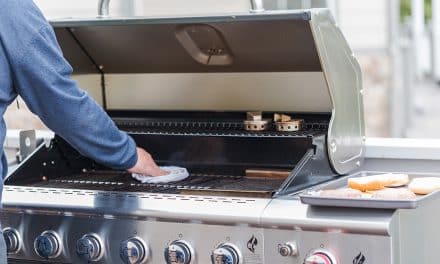
The grill lid does more than cover the cooking surface. It helps retain and circulate heat, enables indirect cooking and protects internal components when the grill is not in use.
Many premium grill hoods use double-wall construction for improved heat retention and to reduce discoloration on the exterior surface. Hinges, springs, stops and handles help control the hood’s movement and weight.
Dark flakes on the inside of a grill lid are often mistaken for peeling paint. In many grills, the interior is unpainted, and the material is accumulated grease and carbon that has dried and begun to release from the surface. The grill’s manual should be consulted before assuming the hood coating has failed.
Grease Management System, Drip Tray and Grease Pan
A well-designed barbecue directs grease away from the active burner area into a removable drip tray, grease pan or collection cup. Some grills use channels or angled firebox surfaces to guide grease toward the tray.
The system only works when those passages remain open and the collection container is emptied. Grease can harden, overflow or accumulate in areas it was never intended to remain.
Why Grease-System Maintenance Matters
- Reduces accumulated fuel for grease fires
- Helps control excessive smoke and odors
- Prevents trays and cups from overflowing
- Makes it easier to identify leaks or drainage problems
- Helps keep grease away from burners and ignition components
A high-heat burn-off does not empty the grease tray or remove material from the bottom of the firebox. Read why grease buildup can become a serious problem inside a barbecue .
Not Sure Which Grill Part Is Causing the Problem?
Several BBQ components can produce the same symptom. Pro Grill provides professional grill inspection, diagnosis, cleaning and repair so you do not have to replace parts by guesswork.
Control Knobs
Control knobs are the parts you turn to open, close and adjust the gas valves. Although the knob is visible, it is not the valve itself. The knob fits over a valve stem behind the control panel.
Knobs may crack, melt, fade or lose their internal mounting shape. Markings can also wear away, making it difficult to identify the burner position or heat setting.
A knob that spins without controlling the burner may have a damaged internal fitting, but it can also indicate a problem with the valve stem. If a valve is difficult to turn, forcing the knob can break both parts.
Replacement knobs are not selected by appearance alone. Stem shape, depth, orientation and burner markings must match. See our guide to BBQ grill knob repair and replacement .
Ignition System and Ignition Module
The ignition system creates the spark or flame used to light the burners. Depending on the grill, it may use a mechanical piezo igniter, battery-powered electronic module, transformer-powered system, hot-surface igniter or flame-assisted ignition arrangement.
On an electronic system, pressing or turning the ignition control activates the module. The module sends high voltage through ignition wires to one or more electrodes positioned near the burners.
Ignition trouble should be diagnosed by symptom. A grill that does not click has a different likely problem from one that clicks but does not spark. A grill that sparks but does not light may have an electrode-positioning, burner-port, gas-delivery or grounding problem.
Common Ignition Symptoms
- No clicking when the ignition is activated
- Clicking without a visible spark
- A spark that jumps in the wrong location
- Only one electrode sparking
- A burner that lights manually but not from the igniter
- Intermittent ignition
- Delayed ignition after gas has begun flowing
Our dedicated BBQ ignition and igniter guide explains these systems in greater detail.
Ignition Electrodes, Collector Boxes and Wires
The electrode is the point where the ignition spark appears near the burner. A ceramic insulator helps direct the electrical energy toward the intended spark gap. Some grills use a metal collector box or ignition hood around the electrode.
Electrode placement matters. If it is bent too far from the burner, buried in grease or cracked through its ceramic insulation, the spark may not ignite the gas where intended.
Ignition wires connect the module or switch to the electrodes. Heat, grease, rodents, corrosion and accidental pulling during cleaning can damage them. A visible spark at the module or control panel may indicate that electricity is escaping before reaching the electrode.
Gas Control Valves
Valves are the gatekeepers of the grill’s heat. Each main burner generally has a dedicated valve behind its control knob. Turning the knob opens the valve and adjusts the amount of gas directed toward that burner.
Some valves incorporate separate low, medium and high ranges, while others include dedicated positions for ignition. Side burners, rotisserie burners and infrared searing zones may use different valves from the main burners.
A valve that is difficult to turn, does not change burner output, will not remain in position or appears damaged should be evaluated. Gas valves are not parts to disassemble casually, and forcing a stuck valve can create additional damage.
Learn more about BBQ grill valve problems, repair and replacement .
Gas Manifold
The manifold is the main gas-distribution tube or assembly behind the grill’s control panel. It receives fuel from the supply connection and distributes it to the individual valves.
On many grills, the valves are attached directly to the manifold. This means a problem with one valve may sometimes require replacement or service of a larger manifold assembly rather than one small standalone part.
The manifold’s configuration must match the grill model and fuel type. Valve spacing, mounting brackets, inlet location and gas specifications can vary even between similar-looking models from the same manufacturer.
Gas Orifices
An orifice is a small, precisely sized fitting that meters gas from a valve into a burner. Its opening is engineered for the grill’s burner design, fuel type and intended gas pressure.
Propane and natural gas do not normally use the same orifice size. Changing fuel type may require manufacturer-approved changes to orifices, regulators, valves or other components.
Do Not Enlarge an Orifice to Make a Grill Hotter
Drilling an orifice or substituting an incorrectly sized fitting can create improper combustion and unsafe burner behavior. Fuel-conversion and gas-delivery work should follow the grill manufacturer’s requirements and applicable codes.
Gas Hoses and Connections
Hoses carry gas from a propane regulator or supply connection toward the grill’s manifold. They may use threaded fittings, quick-disconnect fittings or manufacturer-specific connections.
Hoses should be routed away from sharp edges, excessive heat and areas where they can be pinched. Visible cracking, abrasion, melting or damage is a reason to stop using the grill until the hose can be properly evaluated and replaced.
A replacement hose must be appropriate for the appliance, fuel type, connection and pressure. A hose that physically connects is not automatically the correct part.
Propane Regulator
A regulator reduces and controls the pressure of propane flowing from the tank toward the grill. It is an important part of the fuel-delivery and safety system.
Some propane systems can enter a restricted-flow or bypass condition when valves are opened in the wrong sequence or gas begins flowing too quickly. This can make all burners appear weak even though the burners themselves are not damaged.
Regulators can also deteriorate or fail. However, “replace the regulator” should not be the automatic answer to every low-heat complaint. Fuel level, valves, orifices, burner condition and other restrictions can produce similar symptoms.
If your BBQ will not reach its normal temperature, read why a gas grill may not be getting hot enough .
Control Panel
The control panel is the front structure that supports and protects the knobs, valve stems, ignition controls and other operating components. It may also house lights, switches, badges and temperature controls.
Grease, weather and high heat can discolor or damage the panel. On older grills, lettering around the knobs may wear away. The panel must also keep valves and igniters aligned with their exterior controls.
Removing a control panel may expose gas and electrical components. Photographing the original wire routing and component placement is important during qualified service work.

Warming Rack
A warming rack sits above the main cooking grates and provides additional space for keeping cooked food warm, gently heating buns or moving food away from direct burner heat.
Warming racks may be stainless steel, porcelain coated or chrome plated. They are often overlooked during cleaning and can accumulate grease and carbon like the main cooking grates.
A damaged rack can sag, interfere with the hood or become unstable. Replacement requires the correct dimensions and mounting arrangement for the grill.
Side Tables and Shelves
Side tables provide workspace for platters, ingredients and grilling tools. Some include utensil hooks, towel holders, side burners or storage compartments.
On freestanding grills, folding shelf hardware and support brackets can loosen or corrode. Avoid placing more weight on a shelf than the manufacturer permits, particularly when it contains a built-in side burner.
Hood Thermometer and Temperature Sensors
A hood thermometer measures temperature near its mounting location, usually high in the grill lid. It does not necessarily represent the exact temperature at the cooking grate.
Heat can vary from side to side and from the grate surface to the top of the hood. For precise cooking, many grill owners use a separate grate-level or food thermometer in addition to the built-in gauge.
Some modern grills use electronic temperature probes, thermocouples or sensors connected to digital controls. These are different from a basic analog hood thermometer and require model-specific diagnosis.
Rear Rotisserie Burner
A rear rotisserie burner is mounted vertically along the back wall of the firebox. It directs heat toward food turning on a rotisserie spit, allowing cooking without relying entirely on the main burners beneath the food.
Rear burners may use ceramic infrared surfaces, ported metal burners or other specialized designs. They can have dedicated valves, orifices, ignition electrodes and safety components.
Because the construction differs from conventional tube burners, aggressive scraping or improper cleaning can damage delicate ceramic surfaces and screens.
Infrared Sear Burner
An infrared burner uses a specialized ceramic, mesh or emitter surface to produce intense radiant heat. These burners are commonly used for high-temperature searing and may be installed in the main cooking area, side burner or rear rotisserie position.
Infrared burners do not always display the same visible flame pattern as conventional burners. Their surfaces can be damaged by impact, grease saturation, thermal shock or improper cleaning.
If an infrared burner lights unevenly, cracks, pops repeatedly or produces abnormal flame outside the intended area, stop using it and have the system evaluated.
Handles, Hinges, Casters and Wheels
Handles and wheels may seem minor compared with burners and valves, but they are important to safe operation. A secure hood handle helps control a heavy lid, while reliable casters support and position a freestanding grill.
Loose handles, broken hood springs, worn hinges and damaged wheels can make a grill difficult or unsafe to move and operate. Replacement hardware should match the grill’s weight and original mounting design.
Never move a grill while it is hot. Before moving a propane grill, shut off the fuel supply and follow the manufacturer’s instructions.
Why Identifying the Correct BBQ Replacement Part Matters
Grill parts are rarely universal. Two burners can have similar dimensions but different port patterns, mounting points or valve relationships. Two knobs may look identical from the front but use different valve-stem shapes. An electrode may fit into the grill yet place the spark in the wrong location.
The best starting point is normally the grill’s manufacturer, model number and serial number. That information may be found on a rating plate inside the cart, behind a door, near the grease tray or on another location identified by the manufacturer.
Dimensions and clear photographs can help, particularly when labels are damaged, but measurements alone do not confirm that a gas-system component is correct.
Information That Helps Identify Grill Parts
- Grill manufacturer
- Complete model number
- Serial number
- Fuel type: natural gas or propane
- Clear photographs of the grill and existing component
- Component measurements
- Description of the problem or operating symptom
Visit our complete BBQ grill parts, repair and replacement guide for additional help understanding replacement components.
Explore Pro Grill’s Detailed BBQ Component Guides
This article provides an overview of the complete grill. The following Pro Grill resources go deeper into individual parts, common problems, cleaning considerations and replacement options.
Should a Grill Part Be Cleaned or Replaced?
Cleaning makes sense when a component is structurally sound and the problem involves removable grease, carbon or debris. Replacement becomes more appropriate when heat, corrosion or age has permanently damaged the part.
For example, a dirty burner port may be cleaned according to the manufacturer’s directions. A burner with a large corrosion hole cannot be cleaned back into its original condition. A grease-covered briquette tray may be serviceable after cleaning, while a tray with a missing support screen needs replacement.
Professional deep cleaning can make this decision easier because grease and carbon often hide the true condition of internal components. Once the grill is apart and the buildup is removed, cracks, holes, failed welds and other damage become much easier to see.
Frequently Asked Questions About Gas Grill Parts
What are the main parts of a gas grill?
The main parts include the grill body and firebox, cooking grates, burners, valves, manifold, orifices, ignition system, electrodes, heat diffusers or ceramic briquettes, grease tray, regulator, hoses, control knobs, hood and thermometer.
What is the part under the cooking grates called?
The part immediately below the cooking grates may be a heat shield, flame tamer, flavorizer bar, ceramic briquette system or briquette tray. The exact name and design depend on the grill manufacturer.
What is the bottom section of a grill called?
The main lower cooking chamber is commonly called the firebox. A removable drip tray, grease pan or grease cup may sit below or within the firebox to collect cooking grease.
What controls the flame on a gas grill?
The control knob turns a gas valve behind the control panel. The valve adjusts gas flow through a precisely sized orifice toward the burner. The knob is the user control, but the valve and orifice perform the gas-metering work.
What part makes a gas grill spark?
The ignition module or piezo mechanism produces the electrical energy, and an ignition wire carries it to an electrode near the burner. The visible spark normally jumps from the electrode to a grounded metal surface.
Why does my grill click but not light?
Clicking indicates that part of the ignition system is operating, but it does not prove the spark is reaching the correct location or that gas is reaching the burner properly. Electrode condition, wire routing, burner ports, gas flow and component alignment may all need to be checked.
Are gas grill parts universal?
Most important grill parts are not universal. Burners, valves, orifices, electrodes, grates, trays and knobs should be matched to the manufacturer and model whenever possible.
Can Pro Grill identify and replace BBQ parts?
Pro Grill provides professional grill inspection and repair and can help identify replacement parts for many major brands. Availability depends on the manufacturer, model, age and condition of the grill.
Can Pro Grill clean the parts inside my BBQ?
Yes. During an applicable professional grill cleaning, Pro Grill removes accessible cooking components, addresses grease and carbon buildup and inspects exposed parts for visible deterioration. Cleaning methods depend on the material and condition of each component.
Need Help Cleaning, Diagnosing or Replacing Grill Parts?
Pro Grill provides professional mobile BBQ cleaning, inspection and repair. We service many leading built-in and freestanding grill brands and can help determine whether a component needs cleaning, adjustment or replacement.
This guide provides general information about gas grill parts and operation. Component names and designs vary by manufacturer and model. Always follow the grill manufacturer’s instructions. If you smell gas, discover damaged gas components or observe abnormal flame near the controls or burner inlet, shut the grill down safely and have the condition professionally evaluated.